
Metatarsalgia (Ball of Foot pain)
Foot pain affects between 13% and 36% of Canadian adults in large population studies. Pain in the ball of the foot is one of the most common reasons people see a doctor or foot specialist.”
Metatarsalgia: Causes, Symptoms and Treatment
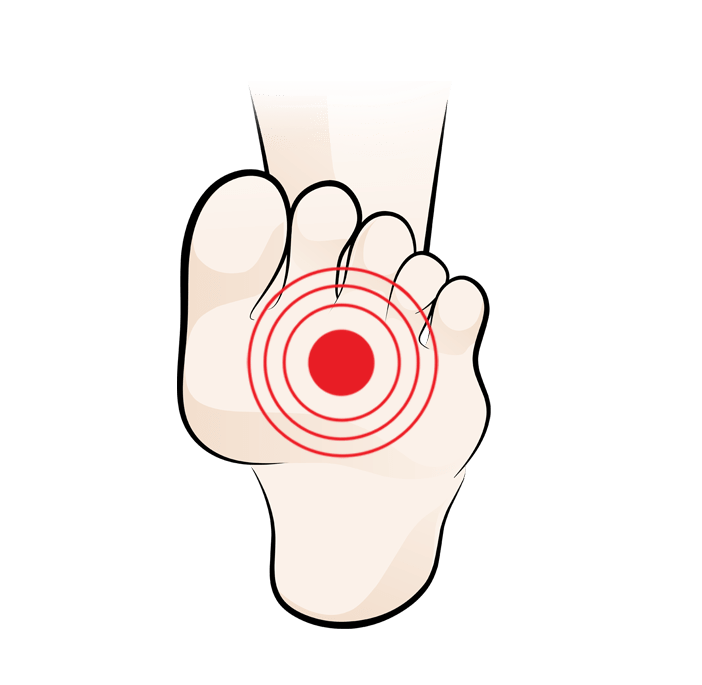
Metatarsalgia is pain under the ball of the foot, in the area where the long bones of the foot (the metatarsals) meet the toes. It’s a description of where the pain is, not a diagnosis in itself. Several different problems can cause it. Most cases improve with simple, non-surgical care, but pain that persists should be checked by a foot specialist to find the underlying cause.
Where the pain comes from
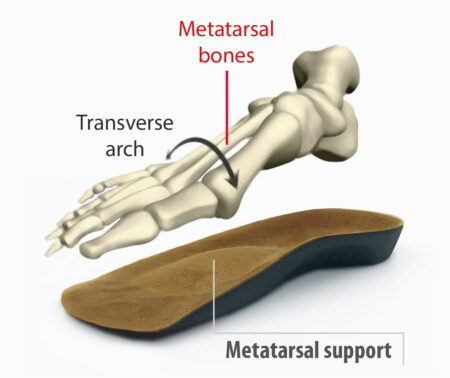
Each foot has five metatarsal bones. Their rounded ends, the metatarsal heads, sit side by side under the ball of the foot and carry much of your weight as you push off with each step. Several structures normally protect them and share the load:
- The plantar fat pad: a thick cushion of fat under the metatarsal heads that absorbs impact.
- The plantar plate: a strong ligament under each toe joint that keeps the joint stable.
- The transverse intermetatarsal ligament: a band that links the metatarsal heads, so they work together and share the load.
In a healthy foot, the metatarsal heads share the load evenly. Metatarsalgia develops when one or more of them takes more pressure than the surrounding tissue can tolerate. That can happen because of the foot’s shape, because a protective structure has thinned or weakened, or because of how the foot is loaded.
Common symptoms of Metatarsalgia
Pain, aching or burning under the ball of the foot, often under the second, third or fourth toe.
Pain that comes on with standing, walking or running, and settles with rest.
Discomfort that's worse barefoot or in thin-soled shoes.
Tenderness when you press under a particular toe joint.
Hard skin forming under one of the metatarsal heads.
A feeling likened to 'walking on a pebble'
Some symptoms point to a different or additional problem. These include numbness or tingling in the toes, swelling over the top of the foot, pain that started suddenly, or pain at night.
What causes metatarsalgia?
A 2021 review in the British Journal of Hospital Medicine groups the causes into three categories (Cooke et al., 2021).
Primary: the shape and mechanics of the foot
- A long second metatarsal: described as the most common structural cause, because the longer bone takes more load at push-off.
- An unstable or short first metatarsal: the big-toe side of the foot doesn’t carry its share, so the neighbouring bones take more.
- High arches and tight calf muscles: both keep the toes and forefoot loaded for longer with each step.
- An enlarged metatarsal head.
Secondary: other conditions
- Toe joint instability, including damage to the plantar plate.
- Morton’s neuroma: an irritated nerve between the metatarsals.
- Freiberg’s disease: loss of blood supply to a metatarsal head, most often in teenagers and young adults.
- Inflammatory arthritis, such as rheumatoid or psoriatic arthritis.
- Injury, such as a previous fracture that healed out of line.
- Neurological conditions that change the shape of the foot.
Iatrogenic: after surgery
Forefoot surgery, such as bunion correction, can change how load is shared across the metatarsals and leave a new pressure point.
Who gets metatarsalgia?
Metatarsalgia is a common reason people see a doctor or foot specialist. It’s particularly common in middle-aged women (Cooke et al., 2021). Other factors that raise the risk include:
- Footwear: narrow toe boxes and heels push weight forward onto the metatarsal heads.
- Body weight: in a study of 796 men, higher body mass index was linked to foot pain (Butterworth et al., 2016).
- Age: the fat pad under the forefoot tends to thin over time.
- High-impact activity: running, jumping and court sports load the forefoot repeatedly.
- Toe deformities: hammer toes and claw toes can pull the fat pad forward, away from the metatarsal heads.
Conditions that can feel like metatarsalgia
Ball-of-foot pain has several possible sources, and where exactly it hurts gives clues (Pelly et al., 2020).
| Condition | Typical location | Clues |
| Morton’s neuroma | Between the third and fourth toes | Burning, tingling or numbness spreading into the toes |
| Plantar plate injury | Under the second toe joint | Swelling; the toe may drift or lift out of line |
| Sesamoiditis | Under the big-toe joint | Pain pushing off or rising onto the toes |
| Stress fracture | Along a metatarsal shaft | Swelling and pain to touch, often after a jump in activity |
| Freiberg’s disease | Second or third metatarsal head | Stiffness and pain in the joint, often in younger people |
Ball of foot pain treatment
Non-surgical care is the first step, and a large number of people get enough relief from it (Cooke et al., 2021). Treatment usually combines several of the following.
Reduce the load on the forefoot
- Cut back temporarily on whatever aggravates the pain, such as long runs, jumping or standing for hours, and keep active with lower-impact exercise.
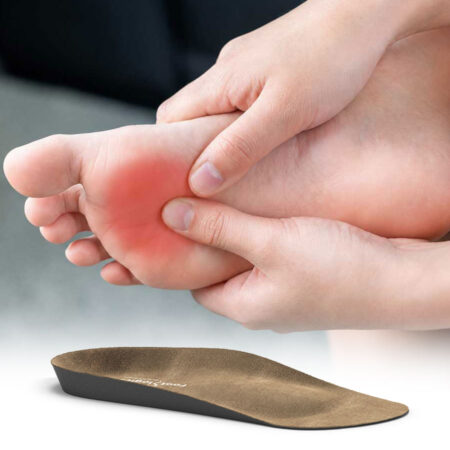
- Offload the painful area with an insole or metatarsal support. A metatarsal pad helps only when it sits in exactly the right spot. Our guide to metatarsal pads explains where it should go, and our page on insoles for metatarsalgia compares the options.
Change your footwear
The Pedorthic Association of Canada recommends shoes that ease strain on the forefoot, with:
- a wide, square toe box
- a heel lower than 2.5 cm (1 inch)
- a thick, shock-absorbing sole
- a stiff sole with a rocker shape
- a firm heel counter
- no stitching over bony areas
Stretch and strengthen: useful exercises for Metatarsalgia
Tight calf muscles keep the forefoot loaded for longer with each step, so calf stretching is a standard part of treatment. The two exercises below loosen the forefoot and strengthen the small muscles in the sole. Move gently, and stop if an exercise causes sharp pain. A physiotherapist can tailor a programme to your feet.
These two simple exercises stretch and strengthen your feet to help ease ball-of-foot pain (metatarsalgia). Done regularly, they loosen the toes and forefoot, build up the small muscles in the sole, and take some of the strain off the front of the foot.
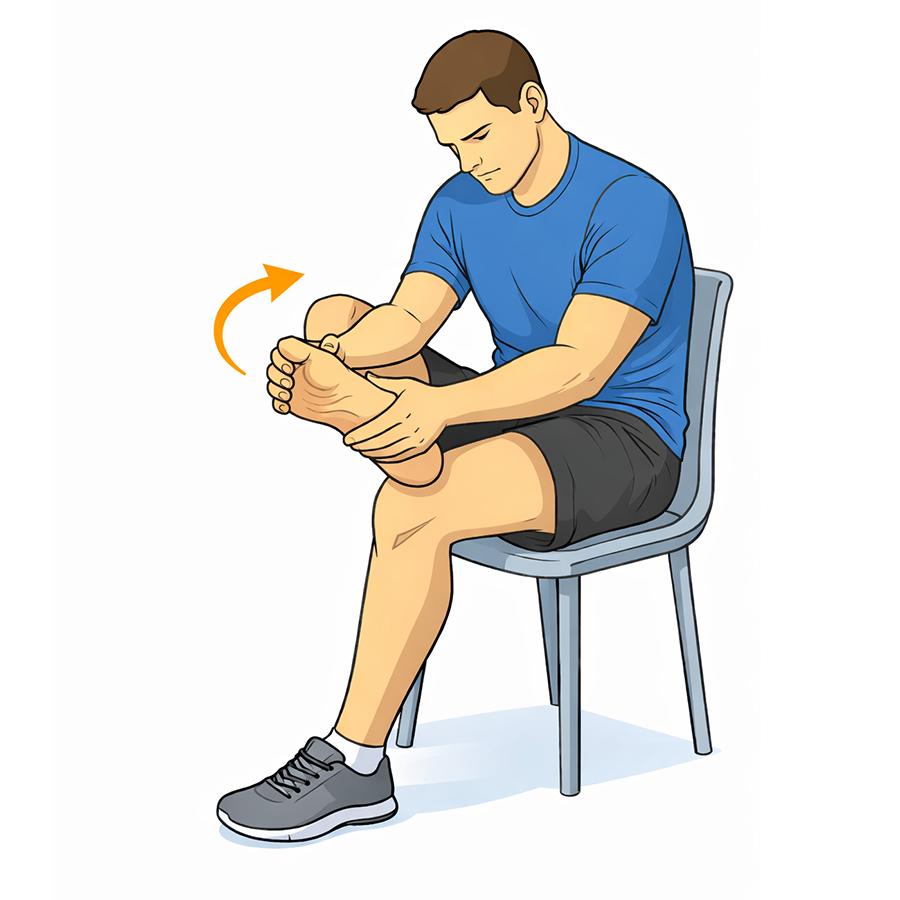
Exercise 1: Toe and forefoot stretch
What it does: eases tension along the sole of the foot and under the toes, taking strain off the forefoot.
- Sit on a chair with both feet flat on the floor.
- Rest one foot across the opposite knee.
- Hold your heel with one hand and wrap the other hand around your toes.
- Gently draw your toes back towards your shin until you feel a stretch along the sole.
- Hold for 20 to 30 seconds, then relax. Repeat three times on each foot.
Why it helps: when the toes and forefoot are stiff, the foot can’t roll smoothly through each step. More of your weight then ends up on the ball of the foot. Restoring that movement helps spread the load.
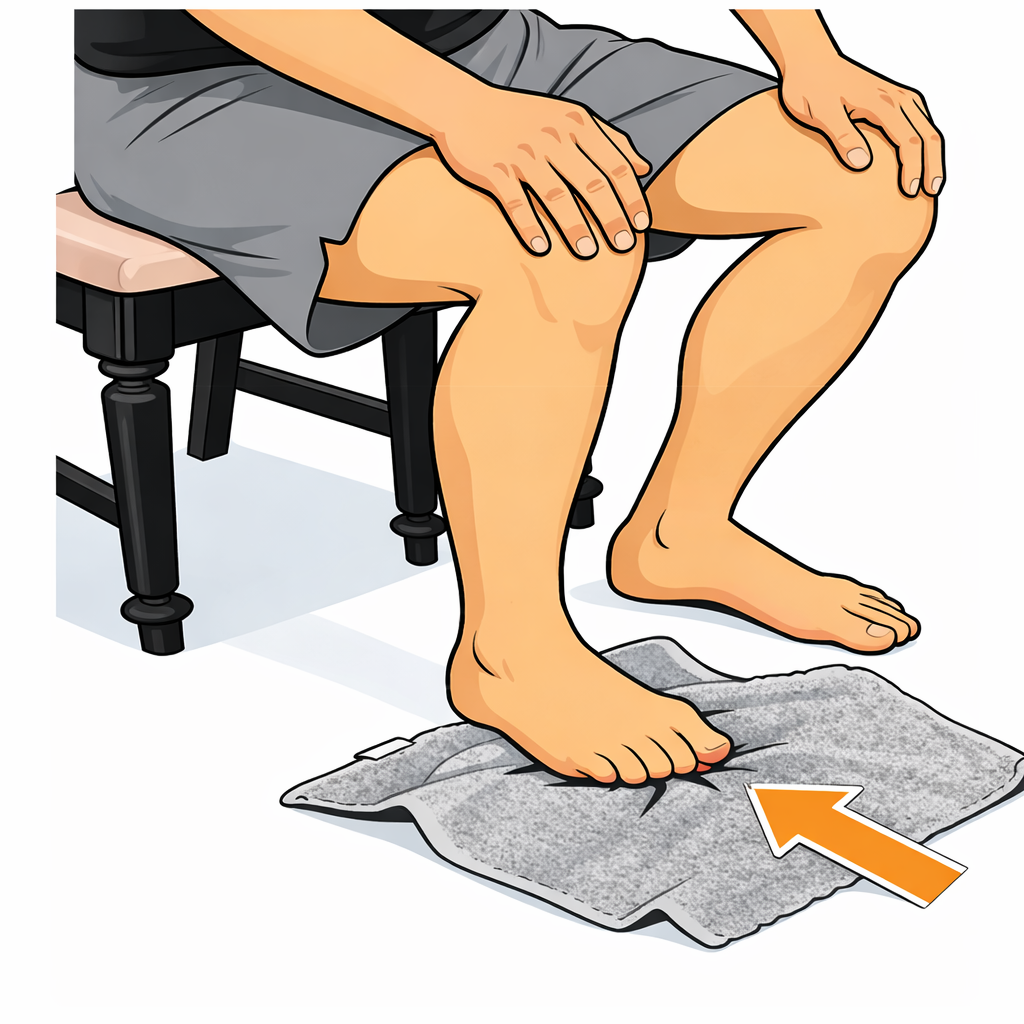
Exercise 2: Towel scrunches
What it does: strengthens the intrinsic foot muscles, the small muscles in the sole that support the arch.
- Sit up straight with a small towel laid flat on a smooth floor in front of you.
- Place one foot on the towel with your heel on the floor.
- Using only your toes, scrunch the towel up and draw it towards you.
- Do 10 to 15 scrunches, two or three times on each foot.
Why it helps: the intrinsic muscles help hold up the arch and control how your foot moves as you stand and walk. When they’re stronger, the forefoot gets more support, and your feet cope better with uneven ground.
Treat hard skin
A chiropodist or podiatrist can safely reduce calluses that add pressure under the ball of the foot.
Injections and surgery
For specific causes, such as a Morton’s neuroma or an inflamed joint, a doctor may suggest a targeted injection. Surgery is considered only when well-managed non-surgical care hasn’t worked, usually after several months. It aims to correct the underlying problem, such as a long metatarsal or an unstable toe joint.
How long does metatarsalgia take to get better?
It depends on the cause and how long the pain has been there. Simple overload, for example after a change in activity or footwear, often settles within a few weeks once the forefoot is offloaded. Pain linked to the foot’s structure, a toe deformity or arthritis tends to need longer-term management. The sooner the cause is identified and the load reduced, the better the outlook.
When to see a professional
See a foot specialist if:
- pain under the ball of the foot hasn’t improved after two to three weeks of rest, better footwear and supportive insoles
- the pain started suddenly, follows an injury or keeps you awake at night
- the top of your foot is swollen, or a toe has started to drift or lift
- you have numbness, tingling or burning in your toes
- a joint is red, hot or swollen
- you have diabetes, poor circulation or reduced feeling in your feet. In that case, have any foot pain or hard skin checked promptly.
In Canada, you can start with your family doctor or see a foot specialist directly. Depending on your province, that may be a podiatrist or a chiropodist. A physiotherapist can help with exercise and loading, and a Canadian Certified Pedorthist can assess your footwear and fit orthotics. Many extended health plans cover some of these visits.
FAQs about Metatarsalgia
Is metatarsalgia serious?
Usually not. Most cases come from too much pressure on the ball of the foot and improve with rest, better footwear and offloading. It’s worth taking seriously, though, because ongoing pain can change the way you walk and lead to problems elsewhere. It can also be a sign of another condition, such as a stress fracture or arthritis, that needs specific treatment.
Can metatarsalgia go away on its own?
Sometimes, if the cause was temporary, such as a sudden increase in walking or a pair of unsuitable shoes. If the cause is still there, the pain usually returns. Reducing the load on the forefoot speeds recovery and lowers the chance of it coming back.
Is it OK to keep exercising with metatarsalgia?
Yes, as long as you choose activities that don’t aggravate the pain. Cycling, swimming and upper-body training keep you fit while the forefoot settles. Return to running, jumping or court sports gradually, and stop if the pain returns.
Is metatarsalgia a type of arthritis?
No, but arthritis can cause it. Metatarsalgia describes pain in the ball of the foot from any cause. Rheumatoid arthritis, psoriatic arthritis and gout can all affect the toe joints and cause similar pain, often with swelling, warmth or morning stiffness. If you notice those signs, see your doctor.
Do I need an X-ray?
Not always. Many people are diagnosed from their symptoms and an examination alone. An X-ray is useful if a fracture, arthritis or a structural problem is suspected, or if the pain hasn’t improved with initial treatment. Your doctor or foot specialist will advise whether imaging is needed.
Which foot specialist should I see in Canada?
Start with whoever you can see soonest: your family doctor, a podiatrist or a chiropodist, depending on your province. They can assess the cause and refer you on if needed. Physiotherapists help with exercise and returning to activity. Canadian Certified Pedorthists specialize in footwear and orthotics.
References
- Cooke R, Manning C, Palihawadana D, Zubairy AI, Khan SHM. Metatarsalgia: anatomy, pathology and management. British Journal of Hospital Medicine. 2021;82(9):1–8. doi:10.12968/hmed.2021.0348
- Pelly T, Holme T, Tahir MA, Kunasingam K. Forefoot pain. BMJ. 2020;371:m3704. doi:10.1136/bmj.m3704
- Butterworth PA, Menz HB, Urquhart DM, Cicuttini FM, Landorf KB, Pasco JA, Brennan SL, Wluka AE. Fat mass is associated with foot pain in men: the Geelong Osteoporosis Study. Journal of Rheumatology. 2016;43(1):138–143. doi:10.3899/jrheum.141331
- Pedorthic Association of Canada. Forefoot pain and metatarsalgia.
WHAT MAKES FOOTLOGICS DIFFERENT?
Footlogics orthotics are designed to deliver medical-grade support and relief — without the cost or wait time of custom orthotics.

TGA-Approved Medical Device
Meets strict medical standards

Developed by Podiatrists
Created for real foot conditions, not generic comfort

Trusted by Health Professionals
Recommended by doctors and physical therapists worldwide
Over 2 Million Pairs Sold
Proven support for everyday life, work, and sport
Available in 20+ countries
Trusted by customers across the globe
Australia’s #1 Orthotic Insole
Leading podiatrist-designed support brand
